The synagogue community of Zell includes the neighbouring villages of Zell Hamms, Pünderich, Briedel, Zell, Merl, Bullay, Alf, Bad Bertrich (up to 80 members in total, as of 1925), whose professions were: merchants, butchers, watchmakers, cloth merchants, innkeepers, wine merchants, tailors.
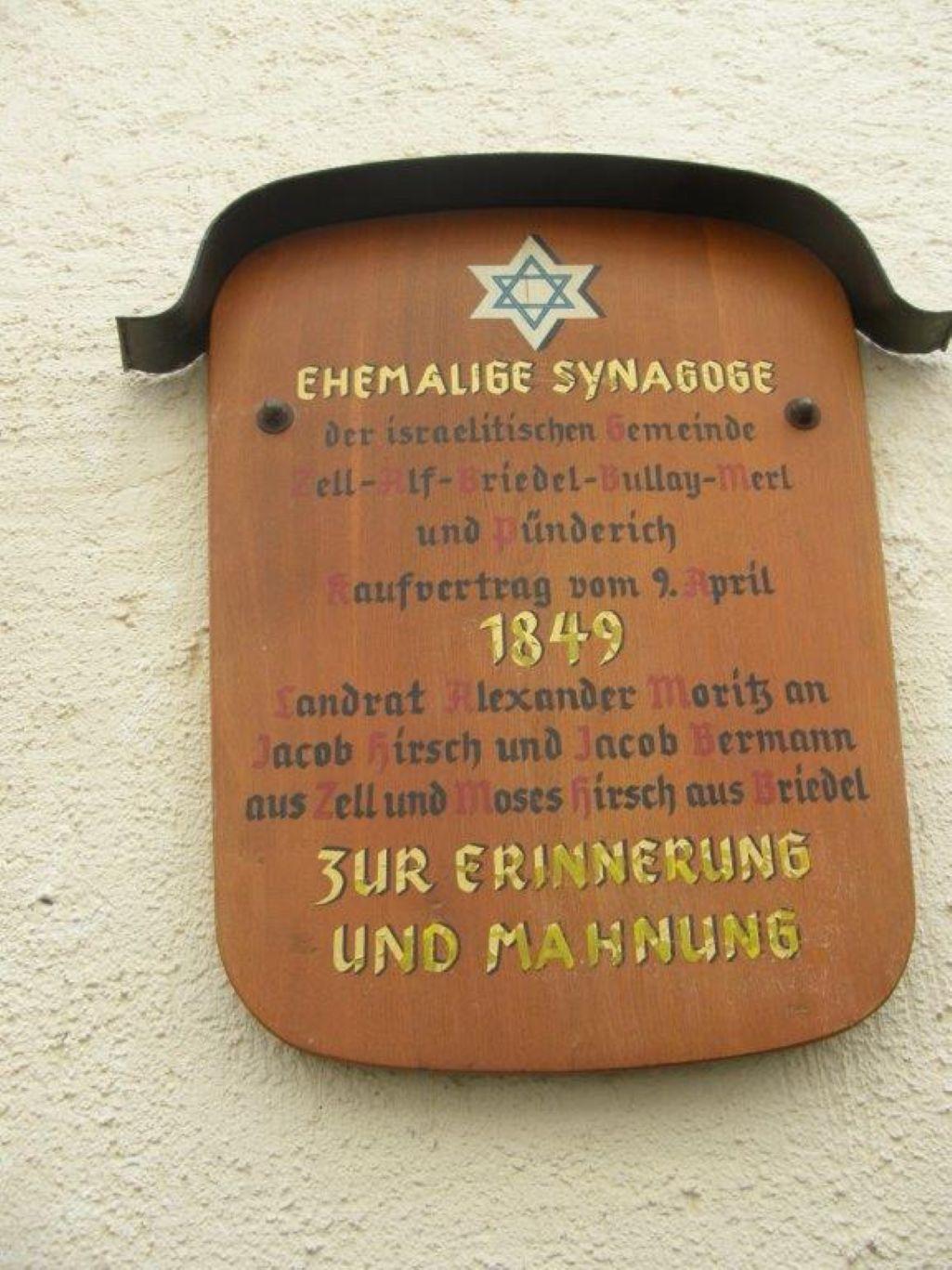
In 1849, the then district administrator Alexander Moritz sold the upper floors of the domestic building belonging to the Zeller Castle for 300 Prussian thalers to the Jewish community of Briedel-Zell. Several construction conditions set by the seller had to be met.
By the mid-1920s, the space was no longer sufficient for all the believers, leading to a renovation that created a women's gallery, added a starry sky, and included a new, larger Torah shrine; a war memorial plaque was installed, and electric lighting was added. The benches were donated by the Essen synagogue community, the menorah, the tablets of the law, and the gable on Jakobstraße were newly created. The two round windows on the east side were bricked up due to the larger Torah shrine, and the walls were decorated with ochre-colored paint.
On the night of November 9 to 10, 1938, the local police, following higher orders, removed all cult objects before SA shock troops unleashed the "outraged public anger over the murder of the German legation councillor von Rath in Paris." The portal door was opened with foreign keys, after which the remaining inventory (benches, Torah shrine, candelabras, windows, and Torah curtain) was destroyed or taken away. According to the police protocol, no looting was allowed (due to the adjoining Electoral Palace).
With that, the life of the Jewish community in Zell came to an end.
In 1939, the butcher Gustav "Israel" Harf from Bullay, as the last remaining synagogue member, sold the building for RM 1000 to the castle owner Bohn. A year later, the textile merchant P. J. Piacenza rented the former house of worship as storage space, also to protect it from further destruction. He wrote the word "kosher" in Hebrew on the inside of the entrance door.
The city mayors of Zell, Döpgen and Bamberg, made efforts to preserve the church as a memorial, but it was only through the change of ownership and the listing as a protected monument that it was possible in 2001 to assign the former synagogue to the "Freundeskreis Synagoge Zell" for use.
In late 2002, restoration of the synagogue could begin.
Until about 1935, the Jews practiced their professions undisturbed. After that, harassment began, and most of the Jewish community members managed to emigrate, especially to the USA, Palestine, South Africa, and South America. Starting in 1940, the Nazis began evacuating; they first deported the remaining members to larger West German cities (Trier, Koblenz, Cologne, Düsseldorf) in order to kill them in the extermination camps of the East from there. From 1936 to 1943, 34 members of the Zell synagogue community lost their lives as a result of the Nazi tyranny.
The Zell community existed for nearly 90 years, ending on November 10, 1938, during the Reich pogrom night.
In 1995, the Cochem-Zell district invited all survivors to a meeting week, with 8 former members of the community attending.

General information
Openings
Dayoff
Monday,Tuesday,Wednesday,Thursday,Friday,Sunday